It’s mid-September, and you’re already feeling the pressure. You know advent calendars are a massive opportunity—the market hit $1.34 billion in 2024 and shows no signs of slowing down. But here’s your problem: every competitor seems to be offering the same chocolate-filled boxes or generic beauty calendars, and you’re wondering how your small business can possibly stand out.
The truth is, the advent calendar gold rush is real, but it’s also becoming increasingly crowded. The brands winning this seasonal battle aren’t necessarily the ones with the biggest budgets—they’re the ones thinking differently about what an advent calendar can be.
That’s where creative advent calendar box design becomes your competitive advantage. It’s not just about what goes inside (though that matters). It’s about creating packaging that stops scrollers mid-swipe, makes gift-givers confident in their purchase, and turns one-time buyers into customers who actively hunt for your calendar every November.
Let’s explore ten innovative advent calendar box ideas that can help your brand capture attention and sales this holiday season, regardless of your product category or budget.
🎁 Idea #1: The Multi-Drawer Tower Design (Premium Feel, Scalable Cost)
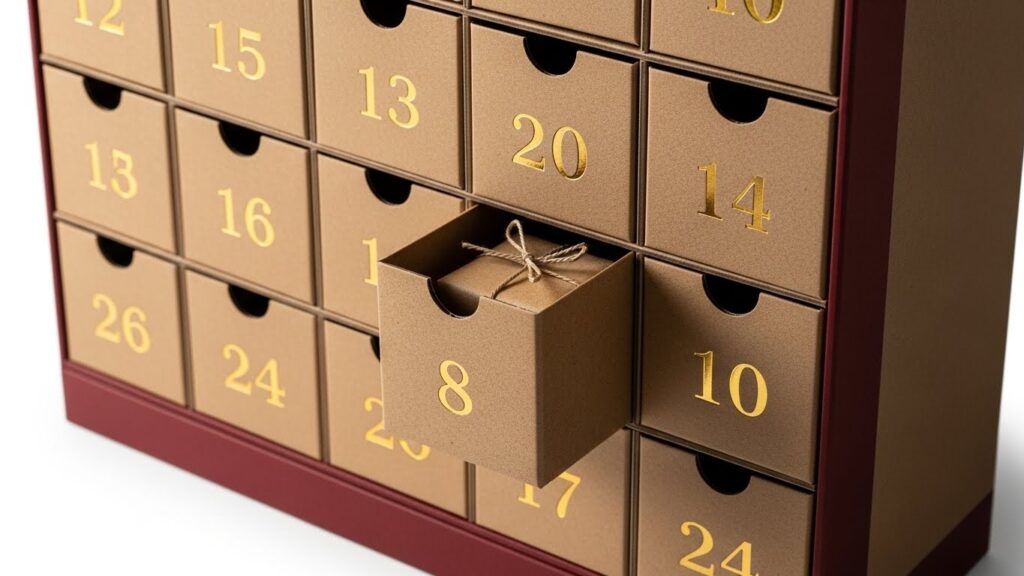
One of the most visually striking advent calendar formats is the vertical tower with individual pull-out drawers. Think of it like a miniature apothecary chest or a jewelry organizer, but seasonally themed.
Why This Design Works
The drawer format creates anticipation with every pull. Each day feels like a separate gift-opening experience rather than just peeling back a paper door. Plus, the vertical structure commands shelf presence in a way that flat calendars simply can’t match.
According to market research from Growth Market Reports, premium and luxury advent calendar formats are driving significant market growth, with consumers willing to pay more for packaging that feels special and reusable.
Making It Work for Your Budget
You might assume drawer-style calendars require prohibitive tooling costs. But here’s the reality: modular designs using standard drawer sizes can be surprisingly affordable when you work with the right packaging partner.
Cost-effective approaches:
- Use kraft paperboard for the main structure (premium look, budget-friendly material)
- Print only on drawer fronts, leaving interior plain
- Create magnetic or friction-fit closures instead of complex hardware
- Design drawers that nest for efficient shipping and storage
Ray Packaging specializes in helping businesses engineer these kinds of structural designs without enterprise-level minimums. They understand that for many small brands, this might be your first premium advent calendar, and you need flexibility.
Product Categories This Works Best For
Beauty and skincare, tea or coffee, jewelry and accessories, artisan chocolates or confections.
If you’re looking to create a substantial presence with maximum storage capacity, a large box advent calendar with the drawer tower format provides both visual impact and practical functionality that customers appreciate long after the holidays end.
🌟 Idea #2: The Keepsake Book-Style Calendar (Storytelling Meets Function)
Imagine an advent calendar that opens like a beautiful coffee table book, with each “page” revealing a new surprise. This format works exceptionally well for brands that want to tell a story throughout December.
The Narrative Power of Book-Style Packaging
Book-style calendars allow you to include micro-stories, facts, recipes, or activities alongside each day’s gift. You’re not just giving products—you’re creating a daily ritual that builds emotional connection with your brand.
Why Customers Keep These Forever
Unlike disposable advent calendars, book-style designs have life beyond December. Customers use them as photo albums, scrapbooks, recipe collections, memory boxes, or decorative coffee table books.
When your packaging has post-holiday value, you’re creating walking advertisements that live in customers’ homes year-round.
Budget-Smart Implementation
Start simple: use heavyweight paperboard pages with glued-on pockets. As your calendar proves successful, you can add complexity like ribbon closures, foil stamping, or premium binding techniques.
Ray Packaging’s design team can help you identify which structural elements will have the biggest impact for your specific price point and product type.
📦 Idea #3: The Modular Cube System (Mix, Match, and Customize)
Here’s an innovative approach that’s gaining traction: instead of one large advent calendar, create a system of 24 individual small boxes that can be stacked, arranged, and customized by the customer.
The Psychology Behind Modular Design
Giving customers agency over how their calendar looks taps into the IKEA effect—people value things more when they’ve had a hand in creating them. A modular cube system transforms passive gift-receiving into active participation.
Design Flexibility for Multiple Products
Advantages of the cube system:
- Each cube can hold different product sizes or shapes
- Customers can display all 24 at once or reveal one daily
- Easy to create advent calendars with varied price points (12-day, 24-day, luxury editions)
- Simplified inventory management if you sell cubes individually
Making It Affordable
Individual small boxes might sound expensive, but they’re often more cost-effective than complex single-structure calendars. Plus, you can offer customers the option to purchase refill cubes for subsequent years, creating recurring revenue.
🎨 Idea #4: The Artistic Flat-Pack Design (Eco-Friendly and Instagram-Worthy)
Sustainability isn’t just good ethics—it’s good business. A well-designed flat-pack advent calendar reduces shipping costs, appeals to eco-conscious consumers, and creates an engaging assembly experience.
The Unboxing-Before-Unboxing Experience
Flat-pack designs require customers to assemble their calendar before the December countdown begins. This might sound like a drawback, but it’s actually an opportunity for extended brand engagement.
The assembly process becomes content-worthy, with customers posting their setup photos on social media. You’ve essentially created two unboxing moments: the assembly and the daily reveals.
Structural Innovation in Flat Design
Modern die-cutting technology allows for surprisingly complex structures that fold flat:
- Pop-up houses or buildings that fold into 3D shapes with interior compartments
- Advent trees with layers that build upward when assembled
- Geometric designs like pyramids or diamonds with hidden pockets
- Hanging displays with individual envelopes or pockets that attach to a wall mount
The Sustainability Story Sells
According to consumer research, sustainability is a major driver in the advent calendar market, with shoppers actively seeking recyclable materials and reusable packaging.
Communicate your environmental benefits:
- “Ships flat to reduce carbon footprint by 60%”
- “100% recyclable materials | No plastic components”
- “Reusable design—refill next year with your own surprises”
Ray Packaging offers a full range of eco-conscious materials that don’t compromise on visual impact. Their FSC-certified papers and plant-based inks check both the sustainability and premium-appearance boxes. Whether you need a cardboard advent calendar box made from recycled materials or virgin paperboard, the quality and visual appeal remain exceptional.
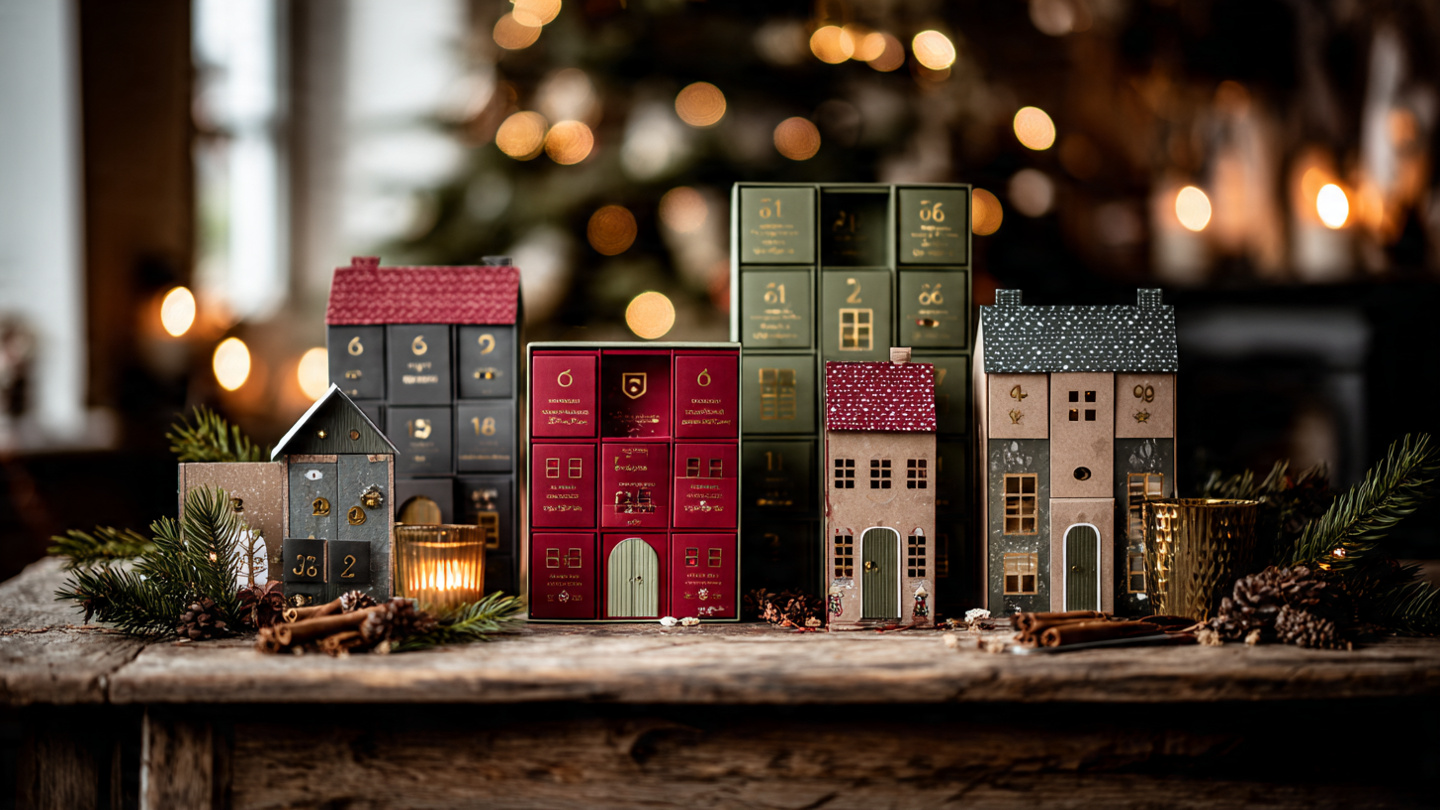
🏠 Idea #5: The Miniature House or Village Calendar (Maximum Charm, Memorable Display)
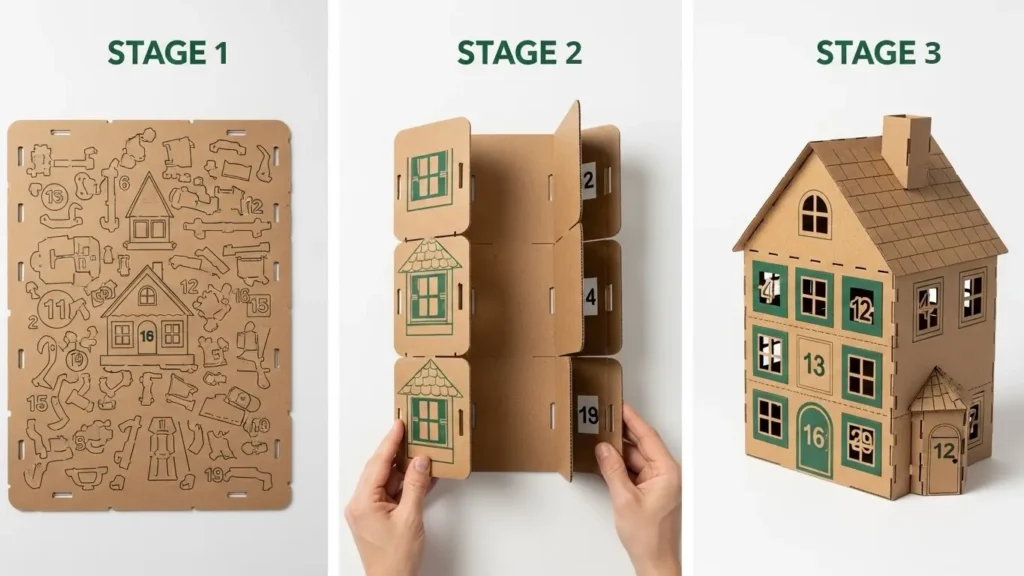
Few things capture holiday magic quite like miniature houses. A calendar designed as a tiny home, cottage, or even an entire village creates instant warmth and nostalgia.
Emotional Resonance of House Designs
Houses tap into universal feelings of home, comfort, and security—exactly the emotions people want to evoke during the holidays. These calendars become centerpieces rather than things hidden in closets after use.
Structural Approaches for House Calendars
Single house design:
- Main structure is the house exterior
- Windows are advent doors that open to reveal treats
- Chimney or roof serves as storage for accessories
- Base provides stability and additional storage
Village concept:
- Multiple small structures representing different buildings
- Each building contains 3-4 days worth of surprises
- Buildings connect to form a cohesive village scene
- Can be displayed together or separately
Making House Designs Affordable
You don’t need complex tooling to create charming house calendars. Strategic use of scoring, tabbing, and simple window cutouts can create impressive dimensional structures using standard paperboard.
Beyond December: Year-Round Decor
The best house-style calendars are so charming that customers display them year-round, even after treats are gone. They become seasonal decor, memory boxes, or even planters. That extended visibility is brand advertising you can’t buy.
💝 Idea #6: The Luxury Rigid Box with Daily Compartments (Worth the Investment)

If your products command premium pricing, your packaging should reflect that value. A rigid box with custom interior fitments signals luxury before a single product is revealed.
When Rigid Construction Makes Business Sense
Rigid boxes cost more than folding cartons, but for certain price points and product categories, they’re actually the most cost-effective choice. A $75-$150 in a flimsy folding carton creates cognitive dissonance. The packaging doesn’t match the price, making customers question the value. But that same product in a solid, beautifully constructed rigid box feels like the luxury purchase it is.
Interior Design Options
Classic compartment layouts:
- 24 individual wells or cells
- Removable trays that reveal layers underneath
- Lift-out inserts that double as display trays
- Combination of compartment sizes for varied products
Premium touches that justify pricing:
- Magnetic closure lids
- Satin or velvet-flocked interiors
- Metallic or soft-touch exterior finishes
- Embossed or debossed branding
- Custom-cut foam or paperboard fitments
The Keepsake Factor
Rigid advent calendar boxes have serious post-holiday value. Customers use them for jewelry organization, craft supply storage, small toy containers, or memory boxes. When you sell a $100 advent calendar, you’re not just selling 24 days of gifts—you’re selling a permanent storage solution.
Working With Ray Packaging on Rigid Designs
Ray Packaging understands that rigid boxes traditionally require high minimums. They’ve built relationships with manufacturers specifically to offer flexible quantities on premium structures, making luxury packaging accessible to growing brands.
🎭 Idea #7: The Interactive Activity Calendar (More Than Just Products)
Here’s a refreshing take: what if your advent calendar wasn’t primarily about physical products, but about experiences? Activity calendars combine minimal products with maximum engagement.
The Experience Economy Meets Advent Calendars
Consumers—especially millennials and Gen Z—increasingly value experiences over things. An activity calendar taps into this preference while potentially reducing your product costs.
What Activity Calendars Include
Daily engagement ideas:
- Holiday recipes with a few key ingredients or tools included
- Craft projects with supplies and instructions
- Acts of kindness or gratitude prompts
- Family game ideas or conversation starters
- Holiday movie suggestions with themed snacks
- Mindfulness or wellness activities
Physical components to include:
- Recipe cards or instruction booklets
- Small tools or supplies needed for activities
- Ingredient samples or starter kits
- Discount codes for related products
- Digital access codes for online content
The Content Creation Opportunity
Activity calendars require significant upfront work in content creation, but this becomes intellectual property you own. You can repurpose activities across multiple seasons, create digital versions, or sell refill packs.
Plus, customers who engage with your activities daily for 24 days develop strong brand affinity. You’re not just a product supplier—you become part of their holiday traditions.
🌈 Idea #8: The Rainbow or Ombré Gradient Design (Visual Impact on a Budget)
Sometimes the most effective innovation isn’t structural—it’s visual. A calendar that features a stunning color gradient creates immediate shelf impact and social media appeal.
The Psychology of Color Gradients
Our brains find gradients inherently pleasing. They suggest progression, transformation, and journey—perfect metaphors for the countdown to Christmas. Plus, they photograph exceptionally well, making them natural candidates for viral social media posts.
Structural Simplicity, Visual Complexity
Here’s the beauty of gradient designs: you can use relatively simple structural formats and let color do the heavy lifting.
Simple structures that work brilliantly:
- 24 identical boxes arranged in color order
- Single large box with numbered pockets in gradient shades
- Envelope or pouch wall-hanging in rainbow sequence
- Tube or cylinder with color-blocked sections
Cost-Effective Implementation
Full-color printing might sound expensive, but gradient designs often use solid color blocks, which can be achieved with spot colors or even colored paperboard, both more affordable than full CMYK printing.
Ray Packaging can help you identify whether spot colors, colored substrates, or full-color printing makes the most sense for your specific design and quantity.
📅 Idea #9: The Countdown Calendar with Reversible Design (Two Products in One)
Here’s a clever innovation: create an advent calendar that serves a second purpose after December 25th. Reversible or transformable designs extend your packaging’s useful life and increase perceived value.
The Transformation Concept
Post-advent uses:
- Flip the calendar to reveal a 2026 wall calendar
- Reconstruct pieces into a decorative item or organizer
- Inside surfaces feature different designs for year-round display
- Components separate into individual gift boxes or containers
Marketing the Multi-Use Angle
This isn’t just clever packaging—it’s a selling point:
- “This calendar doesn’t end on December 25th”
- “Transform your advent calendar into a year-long organizer”
- “Sustainable design that keeps giving all year”
Consumers increasingly resist single-use items. Giving them a product that evolves extends its value proposition dramatically.
🎪 Idea #10: The Surprise Format Calendar (Breaking All the Rules)
The most innovative advent calendar might be the one that challenges everything we expect advent calendars to be. Let’s explore some truly unconventional formats.
Why Weird Works
In a market saturated with similar offerings, dramatically different formats create conversation and press coverage. Novelty is newsworthy, and newsworthy drives sales.
Unconventional Format Ideas
Non-traditional structures:
- Advent calendar designed as wearable jewelry or clothing item
- Edible packaging (think gingerbread house that IS the calendar)
- Inflatable or fabric calendars (soft goods instead of boxes)
- Puzzle calendar where pieces are revealed daily and assembled
- Digital-physical hybrid (AR app unlocks physical products)
The Risk-Reward Calculation
Truly unconventional calendars are riskier. They won’t appeal to everyone, and that’s exactly the point. You’re not trying to capture the mass market—you’re trying to create something so distinctive that your specific audience can’t resist it.
Testing Unconventional Concepts
This is where flexible manufacturing partners become essential. You need to be able to test weird ideas with small production runs before committing to large quantities.
Ray Packaging’s approach to minimums makes innovation affordable. You can try a bold format with 250-500 units, gauge response, and scale up if it works—or pivot if it doesn’t.
💡 Making Your Choice: Matching Calendar Design to Your Brand
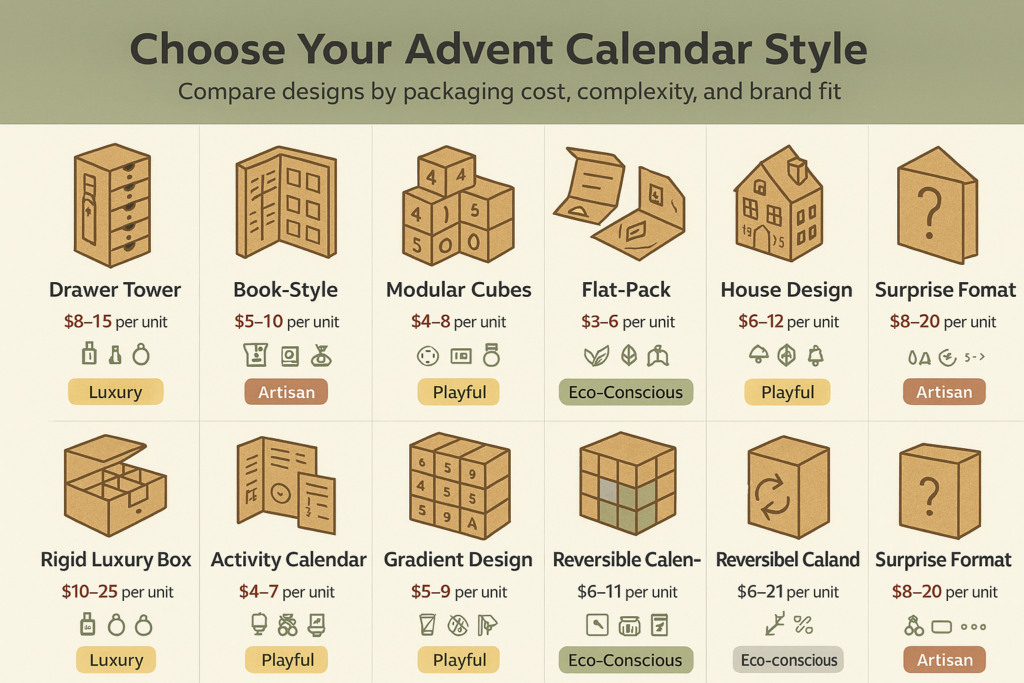
With ten distinct approaches, how do you choose? Start by asking these critical questions:
Know Your Customer Psychology
Gift buyers vs. self-purchasers:
- Gift buyers prioritize presentation and perceived value
- Self-purchasers care more about contents and reusability
Age demographics:
- Younger customers (18-35) value Instagram-worthiness and sustainability
- Middle-aged buyers (35-55) balance quality with value
- Older customers (55+) prefer classic, sturdy designs
Align With Your Brand DNA
Your advent calendar should feel like a natural extension of your brand:
- Minimalist brands → Simple structures with sophisticated finishes
- Playful brands → Interactive or colorful formats
- Luxury brands → Rigid boxes with premium materials
- Eco-conscious brands → Sustainable materials with clear messaging
- Artisan brands → Craft-focused or handmade aesthetics
Consider Your Production Realities
Budget constraints: Start with simpler structures and premium finishing touches. Use colored substrates instead of full-color printing. Focus design energy on exteriors, keep interiors simple.
Lead time: Complex structural calendars require longer production times. Plan 4-6 months ahead for custom advent calendar production.
Storage and fulfillment: Large dimensional calendars cost more to ship and store. Flat-pack or nested designs reduce logistics costs.
🚀 Working With Ray Packaging to Bring Your Vision to Life
Creating a successful advent calendar requires more than just choosing a format—it requires a packaging partner who understands both the seasonal opportunity and the challenges small businesses face.
The Ray Packaging Difference for Advent Calendars
Flexible minimums for seasonal products: Unlike traditional packaging manufacturers who require 5,000+ units, Ray Packaging works with advent calendar quantities as low as 250-500 units, making it feasible to test the market.
Design expertise included: Their team doesn’t just execute your ideas—they help refine them. They’ll identify potential structural issues, suggest cost-effective alternatives, and optimize your design for both impact and budget. Whether you need a custom advent calendar box with unique structural features or want to adapt an existing design to your brand, their expertise ensures your vision becomes reality.
Timeline planning: Advent calendars have hard deadlines. Ray Packaging’s production planning helps you work backward from your November 1st target launch to ensure everything arrives on time.
Sustainable options standard: Every advent calendar option includes sustainable material choices—recycled paperboard, plant-based inks, and biodegradable components—without premium pricing.
📞 Start Planning Your 2026 Advent Calendar Today
The advent calendar market is projected to reach $2.65 billion by 2033, growing at 8.2% annually. That growth represents opportunity, but also increasing competition. The brands that will capture market share are the ones planning now, not scrambling in August.
Your advent calendar could become your biggest seasonal revenue driver—a product customers actively search for and purchase year after year. But only if the packaging matches the quality and thoughtfulness of what’s inside.
Ray Packaging is ready to help you transform your advent calendar vision into a reality that delights customers and drives sales. Reach out today to start the conversation about your 2026 advent calendar project.
Because in a market this crowded, creativity isn’t optional—it’s your competitive advantage.
❓ Frequently Asked Questions
When should I start planning next year’s advent calendar?
Ideally, begin planning 8-10 months before your intended launch date. For a November 2026 launch, start design work by January-February 2026. This timeline allows for proper concept development, design refinement, production, and any unexpected delays. Ray Packaging can work with tighter timelines, but earlier planning gives you more flexibility and typically better pricing.
What’s the minimum order quantity for custom advent calendar boxes?
Ray Packaging offers advent calendar minimums starting at 50 units depending on structural complexity, compared to industry-standard minimums of 5,000+. This makes custom advent calendars accessible for small businesses testing the market or creating limited-edition seasonal offerings. Lower minimums also reduce financial risk and inventory storage challenges.
How much should I budget per calendar for packaging?
Packaging costs typically range from 15-30% of your retail price for advent calendars, depending on structural complexity and finishing options. For a $50 retail calendar, expect $7.50-$15 in packaging costs. Premium rigid boxes with special finishes will be at the higher end, while folding cartons with strategic design elements can achieve impact at the lower end.
Can I create an eco-friendly advent calendar without sacrificing visual appeal?
Absolutely! Modern sustainable materials rival traditional options in visual quality. Recycled paperboard with plant-based inks, FSC-certified papers, and biodegradable coatings all create stunning results. In fact, many premium brands are choosing sustainable materials specifically because they add authenticity and align with modern consumer values. Ray Packaging specializes in eco-conscious options that don’t compromise aesthetics.
What makes an advent calendar design “Instagram-worthy”?
Visual appeal on social media comes from bold color choices, dimensional structures that create interesting shadows and depth, surprise elements that encourage unboxing videos, and cohesive aesthetic that photographs well. Consider including special touches like ribbons, wax seals, or metallic accents that catch light. Most importantly, the calendar should tell a visual story that makes people want to share their experience with their followers.