It’s September, and you’re brainstorming your holiday product line. You want to create something special—an advent calendar that customers will actually get excited about. But as you start researching packaging options, you hit a wall. Minimum order quantities of 10,000 units. Design fees that eat your entire budget. Generic templates that look like everyone else’s.
Sound familiar?
Here’s the truth: creating stunning advent calendar boxes shouldn’t require a corporate-sized budget or settling for cookie-cutter designs. Whether you’re a small business launching your first holiday collection or an established brand looking to stand out, understanding the fundamentals of advent calendar packaging can transform your seasonal offering from forgettable to Instagram-worthy.
In this comprehensive guide, we’ll break down everything you need to know about designing, selecting materials for, and printing custom advent calendar boxes that captivate customers and boost your holiday sales—without the packaging industry’s usual headaches.
🎨 Design Fundamentals: Creating Advent Calendars That Stand Out
Understanding the Core Structure Options
Before you dive into colors and graphics, you need to choose the right structural foundation for your advent calendar. This decision impacts everything from how customers interact with your product to your final production costs.
The most popular structural styles include:
- Drawer-style boxes: Individual sliding compartments create a premium unboxing experience
- Window calendars: Pre-cut numbered windows with perforations for daily reveals
- Book-style designs: Hinged covers that open to reveal compartments inside
- Tower configurations: Stacked boxes that create vertical visual impact
- Magnetic closure designs: Reusable formats with magnetic flaps for each day
Each style serves different product types and customer experiences. Jewelry brands often prefer drawer-style designs for their luxurious feel, while food products work beautifully in window formats that keep items secure. If you’re creating an impressive display piece, a large box advent calendar design can make a stunning visual statement that dominates retail shelves and social media feeds.
The Psychology of Color in Holiday Packaging
Your color choices do more than look pretty—they trigger emotional responses that influence purchasing decisions. According to research from the University of Loyola, Maryland, color increases brand recognition by up to 80%, making it a critical factor in packaging design that influences purchase behavior.
For advent calendars, you’re balancing holiday tradition with brand identity. Here’s what works:
Traditional Holiday Palettes:
- Deep reds and forest greens signal classic Christmas nostalgia
- Gold and silver accents add premium positioning
- Navy blue with white creates elegant, modern winter aesthetics
Modern Alternatives:
- Millennial pink and sage green for contemporary, Instagram-friendly appeal
- Minimalist black and white with metallic accents for luxury brands
- Jewel tones (emerald, ruby, sapphire) for sophisticated differentiation
Don’t feel trapped by convention. Ray Packaging has helped tea companies create stunning lavender and cream advent calendars, and beauty brands succeed with all-black luxury designs.

Typography That Actually Gets Read
Your advent calendar competes for attention on crowded retail shelves and busy Instagram feeds. Typography choices make or break that first impression.
Skip the generic script fonts everyone uses. Instead, consider these proven approaches:
- Bold sans-serif for product names: Maximum readability at any size
- Decorative fonts for “Advent Calendar” only: Creates visual interest without chaos
- Clear, legible numbers: Customers should instantly identify each day
- Hierarchy matters: Your brand name deserves prominence over generic holiday messaging
Remember, your packaging will be photographed and shared. Fonts need to look sharp in person and on screens.
Space Planning and Layout Wisdom
Here’s where many brands stumble: they cram too much onto the packaging. Your advent calendar box needs strategic white space.
Think about what customers actually see:
Front panel priorities:
- Your brand name (largest element)
- Product type or theme
- Eye-catching visual element or hero image
- Minimal text—save details for other panels
Side panels:
- Product information and ingredients (if applicable)
- Brand story or message
- Social media handles
- Barcode and regulatory information
Back panel:
- Contents guide or product list
- Usage instructions if needed
- Sustainability messaging
- Contact information
The best designs guide the eye naturally, creating visual flow that feels intentional rather than cluttered.
📦 Material Selection: Building Calendars That Last and Impress

Paperboard Options and When to Use Each
Not all cardboard is created equal, and your material choice directly impacts both customer perception and product protection. Whether you’re exploring cardboard advent calendar box options or considering premium materials, understanding the differences helps you make the right choice for your brand.
Single-wall corrugated (B-flute or E-flute):
- Provides cushioning for delicate items
- Best for calendars with heavier products
- Creates a substantial, premium feel
- Slightly higher cost but worth it for protection
SBS (Solid Bleached Sulfate) paperboard:
- Smooth, bright white surface ideal for vibrant printing
- Perfect for cosmetics, candles, and lightweight products
- Takes detailed graphics beautifully
- Most common choice for retail-ready advent calendars
Kraft paperboard:
- Natural brown aesthetic appeals to eco-conscious customers
- Costs less than bleached options
- Excellent for rustic, organic, or artisan brands
- Prints beautifully with darker ink colors
Chipboard:
- Budget-friendly option for simple designs
- Works well for minimalist aesthetics
- Not ideal for intricate printing or coatings
- Best for products where packaging isn’t the primary selling point
Ray Packaging helps brands match materials to their specific needs—whether that’s museum-quality printing or sustainable simplicity.
Thickness Matters More Than You Think
Board thickness (measured in points) affects everything from durability to perceived value. Here’s your decision guide:
- 12-14 point: Minimum for advent calendars; suitable for very lightweight contents
- 16-18 point: Sweet spot for most products; feels substantial without adding excessive weight
- 20-24 point: Premium tier; necessary for heavier items or reusable designs
- 28+ point: Luxury category; creates gift-worthy presentation
Thicker isn’t always better. A 24-point calendar filled with tea bags creates unnecessary weight and shipping costs. Match thickness to your product and positioning.
Coatings and Finishes That Elevate the Experience
Your base material is just the beginning. Surface treatments transform good packaging into great packaging.
Coating options to consider:
- Matte lamination: Sophisticated, fingerprint-resistant, excellent for detailed graphics
- Gloss lamination: High shine, color pop, traditional holiday feel
- Soft-touch coating: Velvety texture that customers can’t stop touching (seriously, it’s addictive)
- Spot UV: Strategic gloss accents on matte backgrounds create depth and luxury
- Metallic foiling: Gold, silver, rose gold, or holographic foils for premium positioning
Don’t pick finishes randomly. Soft-touch coatings work beautifully for skincare advent calendars, while glossy finishes make food photography pop. Match the tactile experience to your brand personality.
Sustainable Material Choices Your Customers Actually Want
Sustainability isn’t just a buzzword—it’s a purchasing decision factor, especially during the gift-giving season when consumers feel guilty about excess packaging.
Eco-friendly options that don’t sacrifice quality:
- FSC-certified paperboard: Guarantees responsibly sourced materials
- 100% recycled content: Reduces environmental impact without compromising structure
- Soy-based or vegetable inks: Eliminates petroleum-based printing chemicals
- Water-based coatings: Recyclable alternative to plastic lamination
- Biodegradable or compostable materials: Premium option for eco-conscious brands
Be transparent about your sustainability choices. Print “Fully Recyclable” or “Made from Recycled Materials” directly on the packaging. Customers notice and appreciate it.
🖨️ Printing Methods: Bringing Your Vision to Life
Digital Printing vs. Offset Printing Explained
This decision impacts your timeline, budget, and final quality. Let’s break down when each method makes sense.
Digital printing advantages:
- No setup fees or printing plates required
- Perfect for small batch orders (even 50-100 units)
- Quick turnaround—often 5-7 business days
- Easy to test multiple designs without additional costs
- Ideal for personalized or limited-edition calendars
Offset printing benefits:
- Superior color accuracy and consistency
- Cost-effective for larger quantities (1,000+ units)
- Handles specialty inks and Pantone matching perfectly
- Better for intricate details and gradients
- Industry standard for retail distribution
Ray Packaging offers both methods because different brands have different needs. Testing a new product? Digital printing lets you start small. Proven bestseller? Offset printing reduces your per-unit cost significantly.
Color Management and What “CMYK” Actually Means
Here’s where many brands get surprised during production: colors on your screen don’t automatically translate to printed packaging.
Understanding color systems:
- RGB (Red, Green, Blue): Screen colors; what you see on your computer
- CMYK (Cyan, Magenta, Yellow, Black): Printing colors; what actually gets printed
- Pantone/PMS colors: Specific color formulas for perfect brand matching
That bright, vibrant blue on your monitor might print darker and more muted. This isn’t a printing error—it’s physics. RGB uses light; CMYK uses pigment.
How to avoid color disappointment:
- Always design in CMYK from the start
- Request printed proofs before full production
- Invest in Pantone matching for critical brand colors
- Understand that different materials affect color appearance
- Work with printers who provide accurate color profiles
Professional packaging partners like Ray Packaging guide you through color management, ensuring your advent calendar matches your vision.
Special Printing Techniques Worth the Investment
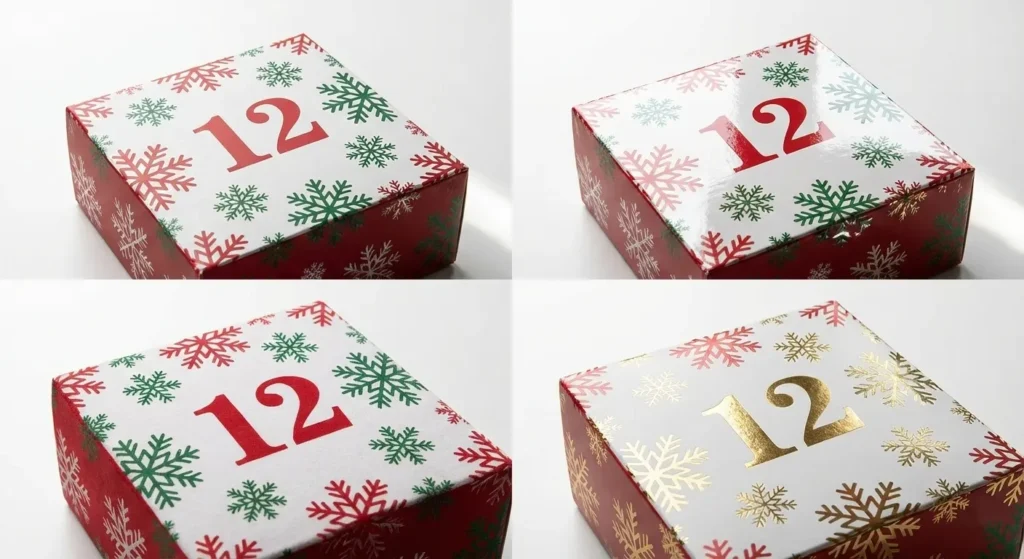
Standard four-color printing is just the beginning. Special techniques create packaging that customers want to keep and photograph.
Premium printing enhancements:
- Foil stamping: Metallic or holographic foils catch light and create luxury
- Embossing: Raised elements add tactile dimension
- Debossing: Pressed-in designs create sophisticated subtlety
- Spot varnish: Selective glossy areas on matte backgrounds
- Metallic inks: Silver or gold inks that shimmer without foil costs
These aren’t just pretty upgrades—they’re strategic differentiators. A beauty brand using rose gold foil stamping creates perceived value that justifies premium pricing. A tea company using embossed patterns tells a story of craftsmanship.
Getting Print-Ready: File Preparation Essentials
Even the best printing technology can’t fix poorly prepared artwork. Here’s what you need to know before submitting designs.
Critical file requirements:
- Resolution: 300 DPI minimum; 600 DPI preferred for crisp details
- Bleed area: Extend designs 1/8″ beyond cut lines
- Safe zone: Keep text and critical elements 1/8″ inside cut lines
- File format: PDF with embedded fonts and images
- Color profile: CMYK (convert RGB files before submitting)
- Outline fonts: Convert all text to outlines to prevent font substitution
Don’t have design experience? Ray Packaging offers design support to help you create print-ready artwork that looks professional and prints perfectly.
🚀 Production Considerations: From Concept to Customer Hands
Realistic Timeline Planning
Holiday products require careful timing. Here’s what actually affects your production schedule.
Typical production phases:
- Design development: 1-3 weeks depending on complexity and revision rounds
- Sample production: 7-10 days for physical prototypes
- Approval and adjustments: Factor in your review time
- Full production: 2-4 weeks depending on quantity and printing method
- Shipping: Variable based on location and method
Smart brands start planning in June for November launches. That might seem early, but it prevents the panic of rush fees and compromised quality.
Minimum Order Quantities That Actually Make Sense
Traditional packaging companies demand 5,000-10,000 unit minimums. That’s absurd for small businesses testing holiday products.
Ray Packaging understands that emerging brands need flexibility. We’ve helped candle makers start with 100-unit orders and tea companies test new blends with 250 calendars before committing to larger production.
Lower minimums let you:
- Test market response before major investment
- Offer limited-edition designs without waste
- Manage cash flow more effectively
- Pivot quickly based on customer feedback
- Reduce inventory risk for seasonal products
Don’t let arbitrary minimums prevent you from creating the advent calendar your customers want.
Quality Control Checkpoints That Matter
Not all packaging defects are created equal. Some are worth rejecting; others are standard manufacturing variations.
Critical quality issues:
- Misaligned printing or cutting
- Color shifts between boxes in same batch
- Structural failures (collapsed panels, weak gluing)
- Coating defects (bubbling, peeling, uneven coverage)
Normal manufacturing variations:
- Slight color differences between production runs
- Minor scoring variations in fold lines
- Small paper grain inconsistencies
Request samples before full production. Physical samples reveal details that digital mockups miss—coating texture, paper weight, structural integrity, and color accuracy.
Assembly and Fulfillment Strategies
Your advent calendar design affects more than aesthetics—it impacts your operational efficiency.
Consider these practical factors:
- Arrives flat or pre-assembled?: Flat packaging reduces shipping costs but requires assembly time
- How easy is product filling?: Can you efficiently load 24 compartments?
- What about retail display?: Does it stand properly on shelves?
- Individual shrink-wrapping?: Protects calendars during shipping and handling
- Master carton configuration?: How many units fit efficiently for storage and shipping?
Ray Packaging designs advent calendars with real-world fulfillment in mind. We’ve helped brands optimize loading processes that went from 5 minutes per calendar to under 2 minutes—saving hours during peak season.
💡 Pro Tips From Brands That Got It Right
Start With Your End Product First
Many brands design beautiful calendars, then realize their products don’t fit properly. Reverse engineer the process.
Measure your actual products. Account for padding if needed. Design compartments that hold items securely without excessive movement. Nothing disappoints customers faster than an advent calendar with crushed or damaged contents.
Think Beyond December
Smart brands design reusable calendars. Customers love keeping beautiful packaging for jewelry storage, small item organization, or using it again next year with different treats.
Add phrases like “Reusable Design” or “Refillable” to your marketing. It justifies premium pricing and reduces customer guilt about waste.
Test With Real People
Your design makes perfect sense to you. But can a customer figure out how to open Day 1 without instructions? Does the numbering confuse anyone?
Give prototypes to friends, family, or focus groups. Watch them interact with it without explaining anything. You’ll discover usability issues you never considered.
Budget for Photography
Your advent calendar will live primarily online before purchase. Budget for professional product photography that shows the unboxing experience, close-up details, and lifestyle contexts.
Great packaging deserves great photography. It’s part of your marketing investment, not an optional expense.
✅ Your Advent Calendar Action Plan

Ready to bring your advent calendar vision to life? Here’s a simple roadmap to guide you from idea to finished product.
Step 1: Define Your Vision
Start by clarifying what makes your advent calendar unique. Who’s your target customer? What products will you include? What experience do you want to create? Sketch out your initial ideas and gather inspiration from successful calendars you admire.
Step 2: Choose Your Design Elements
Select your structural style, color palette, materials, and printing techniques based on what you learned in this guide. Consider your budget and brand positioning. Don’t try to incorporate every premium feature—focus on the elements that matter most to your customers.
Step 3: Create or Refine Your Artwork
Develop your design files or work with a designer to bring your vision to life. Ensure your artwork meets print-ready specifications (CMYK color mode, proper resolution, correct bleed and safe zones). If you’re not confident in your design skills, Ray Packaging offers design support to help you create professional packaging.
Step 4: Start Small and Test the Market
Here’s where Ray Packaging’s approach changes everything. Instead of gambling on thousands of units, start with a small initial order of 100-250 advent calendars. This lets you test your design quality, gauge customer response, and refine your product without massive upfront investment. Fill them with your products, photograph them in real-world settings, and even sell your first batch to collect genuine feedback. Think of this as your market research phase—you’re learning what works before scaling up. With Ray Packaging’s low minimum quantities, you can afford to iterate and improve without the financial pressure that crushes most small brands.
Step 5: Scale Up with Confidence
Once your initial batch proves successful and you’ve made any necessary tweaks, place your larger production order with confidence. You already know customers love your design, the quality meets your standards, and your pricing works. This data-driven approach eliminates guesswork and reduces risk significantly.
Step 6: Prepare for Fulfillment
Set up your product filling and shipping processes. Create a system for efficiently loading your advent calendars. Plan your inventory storage. Coordinate with any fulfillment partners. The easier you make this process, the more you’ll enjoy the busy season.
Don’t navigate this journey alone. Ray Packaging guides you through every step, from initial concept to delivered products ready for your customers. Our team understands the unique challenges small businesses face and offers the flexibility, support, and expertise you need to succeed.
Frequently Asked Questions
How far in advance should I order advent calendar boxes for the holiday season?
Start planning by June and place orders by August for November delivery. This timeline allows for design development, sampling, revisions, and full production without rush fees. If you’re creating calendars for the first time, add an extra month for unexpected challenges and learning curves.
Can I create custom advent calendar boxes with small order quantities?
Absolutely. Unlike traditional packaging manufacturers requiring 5,000-10,000 unit minimums, Ray Packaging works with small businesses and emerging brands. You can start with as few as 100-250 units to test market response, then scale up for future seasons based on actual sales data rather than speculation.
What’s the most cost-effective material for advent calendar packaging?
SBS paperboard with matte lamination offers the best balance of affordability, print quality, and durability for most brands. If sustainability is a priority, FSC-certified or recycled paperboard adds minimal cost. For premium positioning, consider upgrading to thicker stock (20+ point) with soft-touch coating rather than choosing expensive specialty materials.
How do I ensure my advent calendar design prints accurately?
Always design in CMYK color mode, provide high-resolution files (300+ DPI), and request printed proofs before full production. For critical brand colors, specify Pantone numbers and invest in color matching. Working with experienced packaging partners like Ray Packaging ensures your files are print-ready and your expectations align with production capabilities.
Are there minimum design requirements for advent calendar boxes?
Yes. Your artwork needs proper bleed (typically 1/8″ beyond cut lines), safe zones for text and important elements (1/8″ inside cut lines), embedded fonts, and correct color profiles. Additionally, structural designs require specific dieline specifications to ensure proper assembly and functionality. Ray Packaging provides design templates and support to ensure your artwork meets all technical requirements.