You’ve spent months perfecting your product. The quality is there. The pricing makes sense. The branding looks sharp on your website. But when that package lands on a customer’s doorstep – or sits on a retail shelf next to a dozen competitors – does it actually stop someone in their tracks?
That’s the question most brands don’t ask until it’s already costing them sales.
Packaging is one of the most powerful and most underestimated brand visibility tools available to any business. And when it comes to choosing between holographic boxes and standard packaging, the decision goes far deeper than aesthetics. It’s about how your brand is perceived, remembered, and talked about – long after the box is opened.
In this guide, we’re breaking down both options honestly and thoroughly so you can make the right call for your brand.
📦 What We Mean by “Standard Packaging” – and Why It’s Not a Bad Word
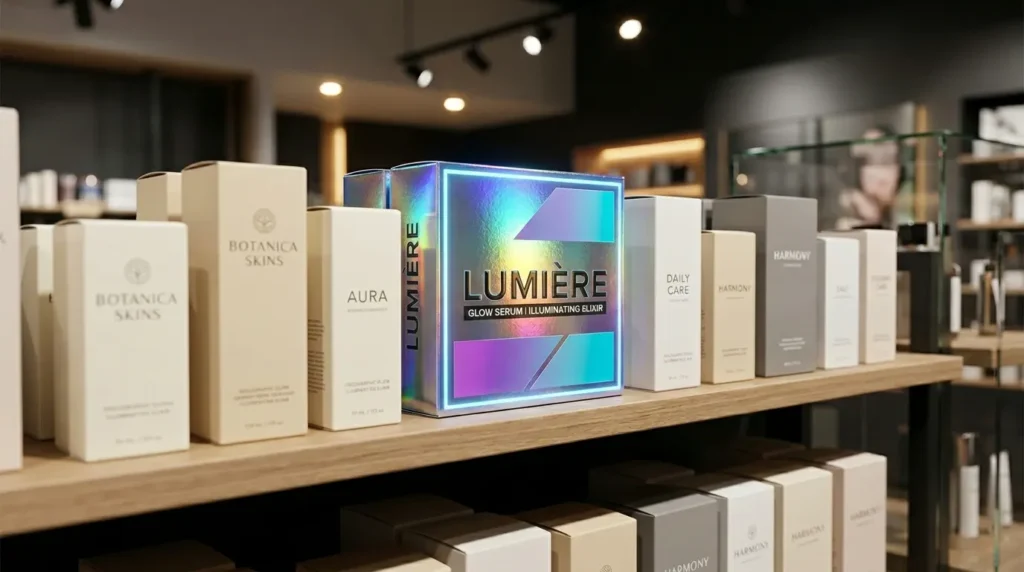
Before we get into the comparison, let’s define our terms. Standard packaging refers to the most commonly used box formats – plain kraft boxes, white cartons, solid-color folding boxes, and basic printed mailers. These are the workhorses of the packaging world, and there’s a reason they’ve dominated for so long.
The Case for Standard Packaging
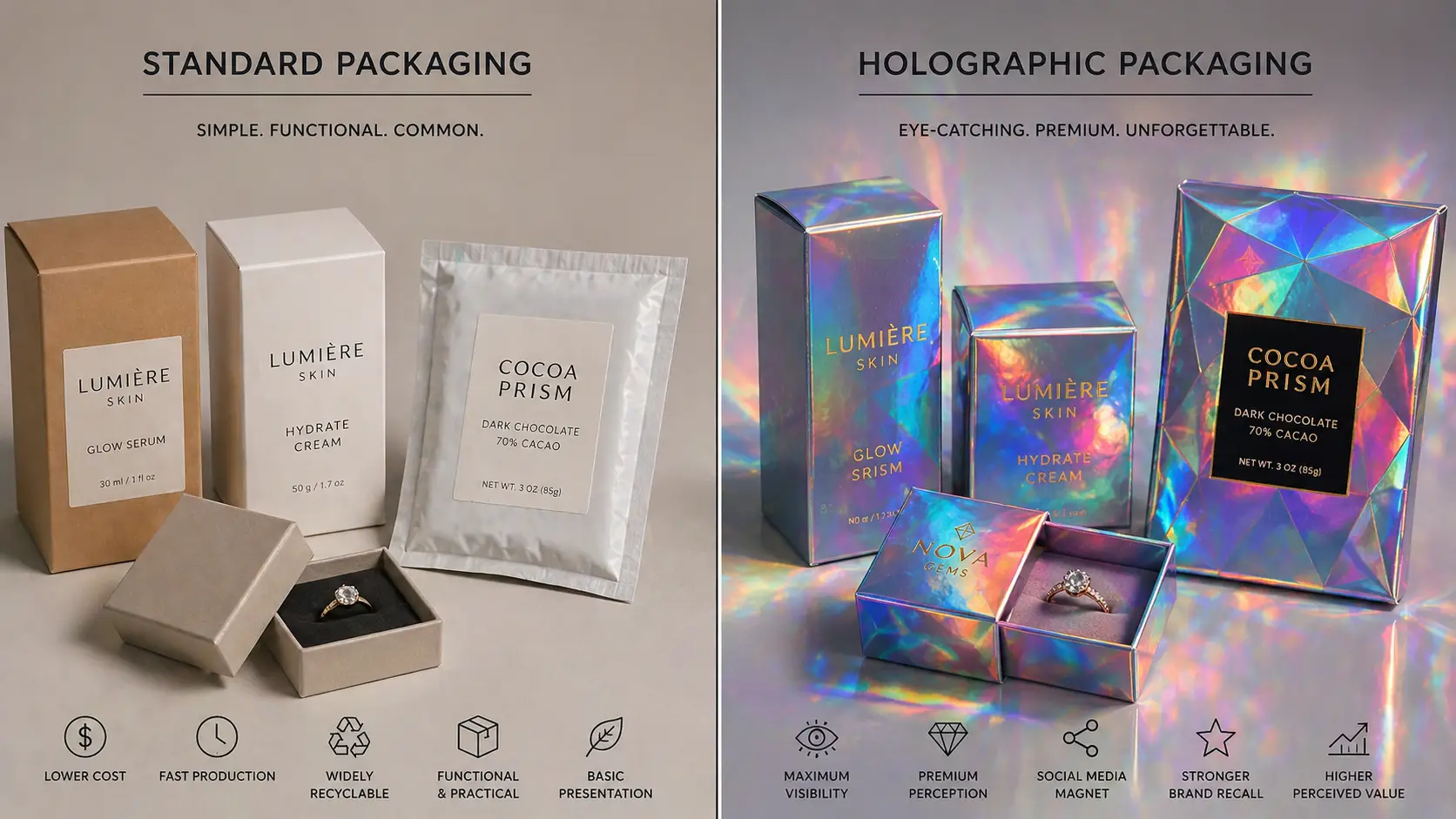
Standard packaging has a lot going for it. It’s cost-effective, widely available, fast to produce, and endlessly versatile. For brands shipping high volumes of everyday products, it often makes complete logistical and financial sense.
Here’s where standard packaging genuinely excels:
- Low cost per unit, especially at high order quantities
- Faster production and turnaround times
- Easier recyclability with widely accepted materials
- Works well for products where the packaging isn’t part of the purchase decision
- Simple to customize with basic print and color
For certain categories – think hardware, everyday household items, or bulk replenishment products – customers simply don’t care about the box. They care about what’s inside, and getting it quickly. In those cases, standard packaging is perfectly sensible.
Where Standard Packaging Falls Short
The problem comes when brands in appearance-driven, gift-oriented, or premium categories rely on standard packaging by default – not because it’s right for them, but because it’s familiar and easy. When your customer is making a buying decision based on perceived value, lifestyle alignment, or emotional connection, a plain brown box sends the wrong message entirely.
Standard packaging in competitive, visual categories essentially says: “We didn’t think too hard about this.” And in a market where packaging is a genuine brand touchpoint, that’s a missed opportunity you simply cannot afford.
✨ What Holographic Boxes Bring to the Table
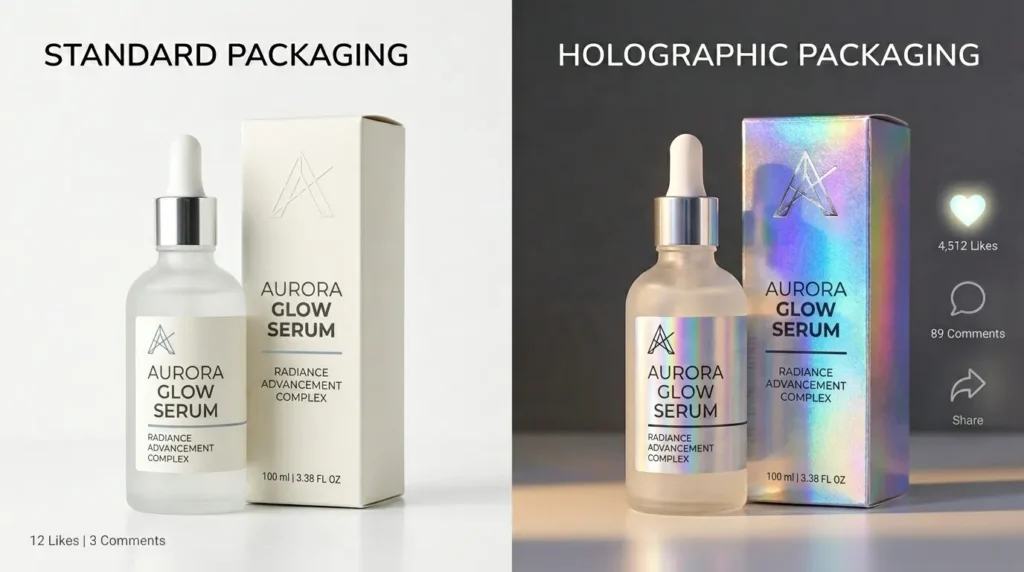
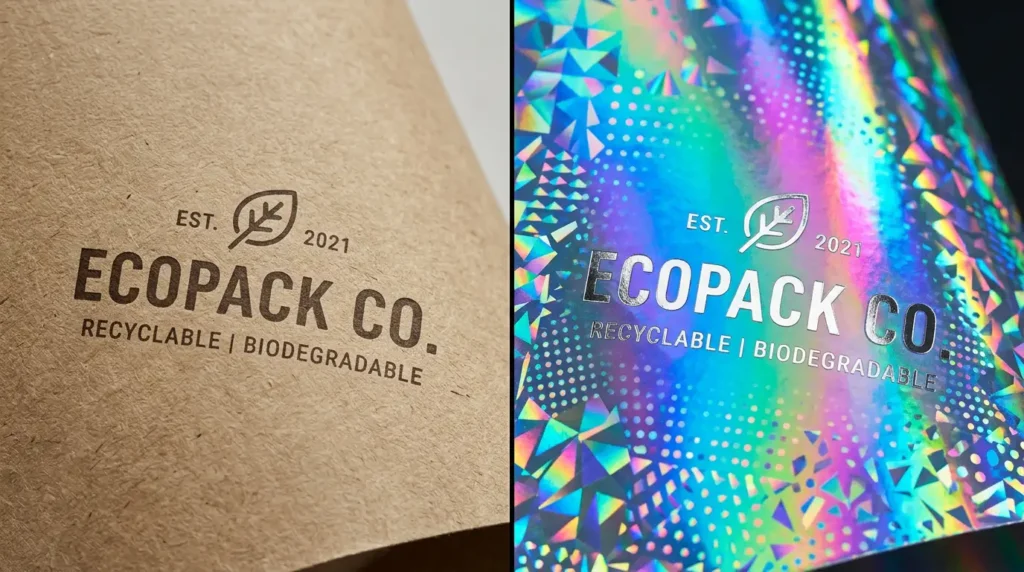
Holographic packaging operates in a completely different register from standard boxes. The technology itself – microscopic embossed patterns on a foil or film substrate that refract light into a full-spectrum shimmer – creates a visual experience that no standard print process can replicate.
The Immediate Visual Impact
The most obvious advantage of holographic boxes is the one you feel before you even consciously process it. According to research published by the Paper and Packaging Board, 7 in 10 consumers agree that packaging design influences their perception of a brand’s quality. Holographic packaging activates that judgment instantly and positively.
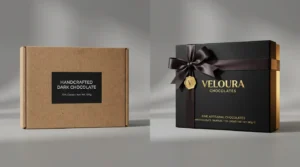
Where a standard box needs copy, color, and design to communicate premium quality, a holographic box communicates it through the material itself. The shimmer does the work before your logo is even read.
Multi-Angle Brand Exposure
Here’s something most brands don’t consider: a holographic box doesn’t look the same from every angle or in every light. It shifts. It changes. It catches the eye differently depending on how it’s held, photographed, or displayed. That dynamic quality means your product naturally draws attention in ways that static, flat packaging simply cannot.
In a retail environment, this is enormously powerful. When light hits a holographic box on a shelf, it creates movement – and movement attracts the human eye instinctively. Your product practically reaches out and grabs the customer’s attention without any additional marketing spend.
The Social Sharing Advantage
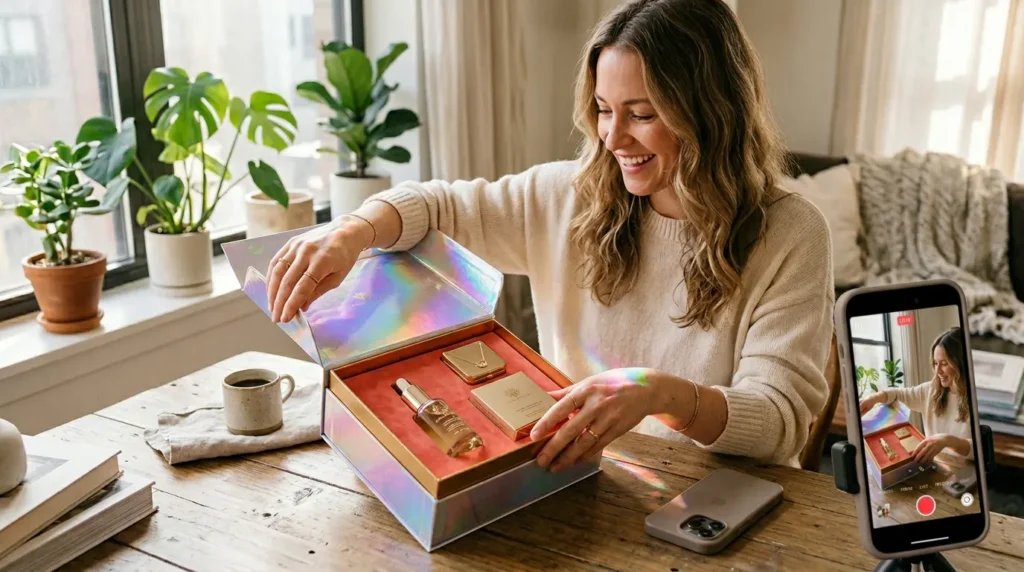
We live in a world where packaging gets photographed, filmed, and shared. Unboxing content generates billions of views annually across YouTube, TikTok, and Instagram – and holographic packaging is almost tailor-made for the camera. The way holographic material interacts with light creates natural visual drama that smartphone cameras capture beautifully.
Standard packaging rarely inspires someone to reach for their phone. Holographic packaging very often does. That organic, user-generated content is effectively free advertising with authentic third-party credibility behind it – and its value adds up fast.
🔍 Head-to-Head: How the Two Options Compare Across Key Brand Visibility Factors
Let’s get specific. Here’s how holographic boxes and standard packaging compare across the dimensions that matter most for brand visibility.
Shelf Presence and Retail Impact
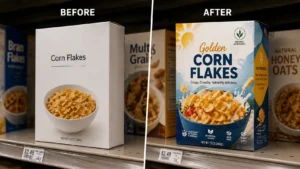
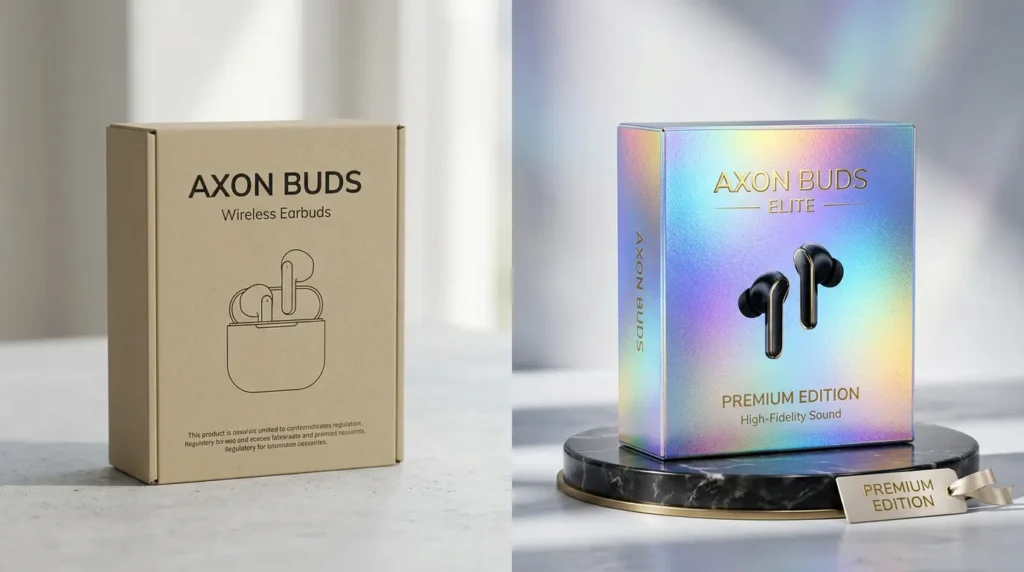
In a retail setting, shelf presence is everything. Products compete for the same square footage and the same few seconds of a shopper’s attention. Standard packaging relies entirely on print – colors, typography, imagery, and layout – to attract the eye. Good design helps, but the material itself is flat and static.
Holographic boxes introduce a physical dimension that print cannot replicate. The light-reactive surface creates genuine visual movement, making your product appear to glow and shift compared to neighboring flat-packed alternatives. In side-by-side testing, holographic packaging consistently draws the eye first – and first attention translates directly into first consideration.
E-Commerce and Photography Performance
For brands selling online, packaging becomes part of the product photography and brand storytelling. Standard packaging can look clean and professional in photos, but it rarely creates visual excitement on its own. Holographic packaging, on the other hand, photographs in a way that’s genuinely difficult to look away from.
The prismatic color shift that makes holographic boxes so eye-catching in person translates powerfully to digital content. Product photos featuring holographic boxes tend to perform better in engagement metrics on social media – more saves, more shares, more comments – because the material creates natural visual interest without any additional styling effort.
Brand Recall and Memory
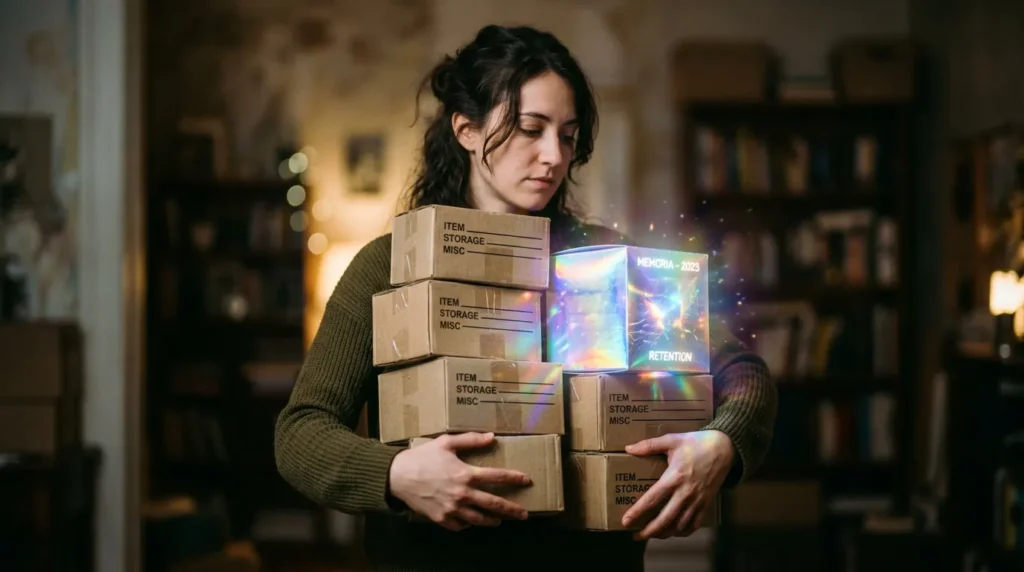
Brand recall – the ability of a customer to remember your brand after an encounter with it – is one of the most important and hardest-to-measure outcomes of packaging. Standard packaging, even when well-designed, can blend into a sea of similarly styled boxes. Without a truly distinctive visual element, it’s difficult to stick in the memory.
Holographic packaging creates a sensory experience that is genuinely hard to forget. The combination of visual shimmer, tactile quality, and the emotional response it triggers – surprise, delight, a sense of receiving something special – all work together to encode the brand more deeply in the customer’s memory. That translates into higher repurchase rates and stronger word-of-mouth.
Perceived Product Value
This is perhaps the most commercially significant difference between the two options. Perceived value – what a customer believes your product is worth before they’ve even used it – is heavily influenced by packaging. Standard packaging sets a neutral baseline. Holographic packaging actively raises it.
When a customer receives a product in a holographic box, they make an immediate unconscious judgment: this brand cares about quality. That judgment influences not just their satisfaction with the current purchase, but their willingness to pay full price on future orders, their likelihood to recommend your brand, and their resistance to switching to a cheaper alternative.
Cost Considerations
Let’s be honest about costs, because they matter. Standard packaging is cheaper per unit – that’s simply a fact. For high-volume, low-margin categories, that cost difference is meaningful and should factor into your decision.
Holographic boxes do carry a higher per-unit cost due to the specialized materials involved. However, the calculation shouldn’t end at unit cost. When you factor in the brand equity built, the organic social content generated, the uplift in perceived value, and the reduction in price sensitivity among customers – the return on that investment becomes a lot more compelling.
At Ray Packaging, we’ve also eliminated the barrier of large minimum orders, so you can explore holographic packaging without committing to thousands of units upfront. That changes the risk equation significantly for smaller brands.
💡 When Holographic Packaging Is Clearly the Right Choice
Not every product needs holographic packaging – and we’d rather help you make the right decision than oversell. But there are categories and situations where holographic boxes win so decisively that it’s hard to argue for the alternative.
You should seriously consider holographic packaging if:
- Your product sits in a premium, gift, or lifestyle category where perception drives purchase
- You sell in a retail environment where shelf differentiation is critical to conversion
- Your customers share their purchases on social media and unboxing content is part of your marketing
- You’re launching a new product and need to make a strong first impression quickly
- Your competitors are using standard packaging and you want a clear visual point of difference
- You sell seasonal, limited edition, or collectible products where the packaging is part of the product’s appeal
- Your brand targets buyers who value design, creativity, and aesthetic thoughtfulness
🎨 When Standard Packaging Still Makes Sense
Equally, there are cases where standard packaging remains the smarter choice – and a good packaging partner will tell you that honestly.
Standard packaging is likely the better fit when:
- Your product category is purely functional and packaging plays no role in the purchase decision
- You’re shipping at very high volumes with extremely tight margins where cost per unit is the dominant variable
- Your brand identity is built around radical minimalism or eco-first values where holographic materials would feel off-brand
- You’re selling B2B or in bulk formats where unboxing experience isn’t relevant
- Your product is already so distinctive that it sells itself regardless of the container
The key insight here is that packaging decisions should always flow from your brand strategy – not default to whatever is cheapest or most familiar.
📊 The Verdict: Which One Wins for Brand Visibility?
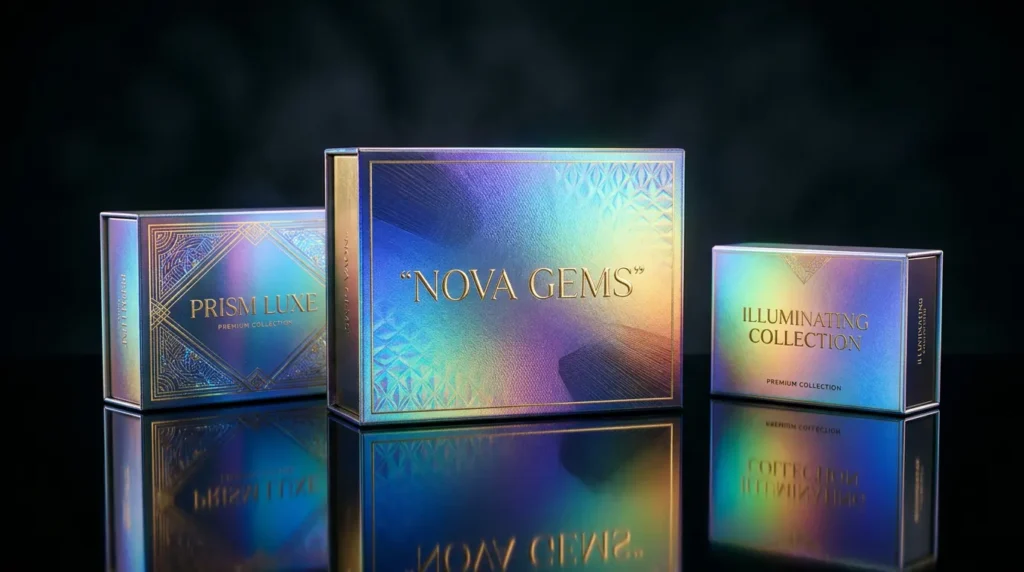
For brand visibility specifically – which is the question we started with – holographic packaging wins, and it isn’t particularly close.
The combination of light-reactive materials, social shareability, shelf differentiation, elevated perceived value, and stronger brand recall gives holographic boxes a decisive advantage in any context where customers are making value-based or emotionally driven purchase decisions.
Standard packaging is a smart, practical choice for the right categories and the right brands. But if you’re selling a product where packaging is a genuine touchpoint in the customer experience – and for most consumer brands, it absolutely is – then standard packaging is leaving brand equity on the table.
The good news is that choosing holographic packaging doesn’t have to mean a massive upfront commitment. At Ray Packaging, we work with brands of every size – from first-time founders to growing product lines – with no minimum order requirements, full design support, and materials that are built to impress.
🚀 How to Make the Switch to Holographic Packaging Without the Guesswork
If you’ve decided holographic packaging is right for your brand – or you just want to explore the possibility – here’s how to approach it smartly.
- Start by defining what you want packaging to communicate. Premium quality? Playfulness? Luxury? Sustainability? Your packaging strategy should emerge from your brand positioning, not be bolted onto it afterward.
- Request samples of holographic materials before committing to a design. Seeing and touching the material in person changes everything. What looks great on screen can look even better – or occasionally different – in your hands.
- Test on one hero product first. Don’t overhaul your entire range at once. Choose your best-selling or most visible product, switch to holographic packaging, and track the customer response carefully.
- Work with a packaging team that understands holographic print. Artwork preparation for holographic substrates is different from standard print – color behavior, contrast, and UV applications all need specialist handling.
- Build your photography and content plan around the new packaging. Holographic packaging is a content asset. Plan dedicated shoots in good natural light, capture video that shows the material shifting, and build social content that lets customers see what they’re going to receive.
Get in touch with Ray Packaging and we’ll help you figure out exactly which direction makes sense for your product – no pressure, just honest guidance.
❓ Frequently Asked Questions
Is holographic packaging only suitable for luxury brands?
Not at all. While holographic boxes do communicate premium quality, they’re used successfully across a wide range of categories – from artisan food and candles to indie beauty brands and children’s gifts. The key is ensuring the packaging aligns with your brand identity and customer expectations. Ray Packaging can help you find a holographic style that fits your brand tone, whether that’s bold and playful or refined and minimal.
Can I use holographic packaging for e-commerce shipping boxes?
Yes – holographic packaging works beautifully for e-commerce applications, particularly for the outer gift box or product box inside a shipping mailer. It elevates the unboxing experience significantly, which is a major driver of social sharing and repeat purchase. Ray Packaging offers a range of holographic box formats suitable for both retail and direct-to-consumer shipping environments.
How much more does holographic packaging cost compared to standard boxes?
Holographic boxes typically carry a higher per-unit cost than standard packaging due to the specialized foil or film substrates involved. However, the difference is smaller than most people expect – especially at moderate quantities – and the return in terms of perceived value, brand recall, and organic social content often outweighs the additional cost. Ray Packaging offers competitive pricing with no minimum order requirements, so you can explore holographic packaging without a large financial commitment upfront.
Will my branding still be visible on a holographic box?
Absolutely – and when done well, your branding looks even more striking against a holographic background than it would on a plain surface. The key is working with a team that understands how to prepare artwork for holographic substrates. At Ray Packaging, our design team handles all the technical nuances – contrast, color behavior, spot UV placement – so your logo and brand elements are bold, legible, and beautifully presented.
What if I want to switch back to standard packaging later?
That’s entirely your call – and there’s no lock-in at Ray Packaging. Because we have no minimum order requirements, you can order holographic packaging for a product launch or seasonal campaign and return to standard packaging afterward if it suits your needs. Many brands choose to run both simultaneously – holographic for gift sets and hero products, standard for everyday SKUs – which gives you the best of both worlds.